Thursday, July 1, 2010
Call For Support
The Association of Prisoners is this generation’s attempt to give prisoners the voice we have long attempted to have heard.
Many other groups and organisations exist which play a role in attempting to change the prison system. Some are small and advocate abolition. Some are large, and advocate slow change. Some groups confine their work to specific subgroups of prisoners while others conduct broad based campaigns.
Along with the AoP, prison reform groups span the full width of political thought and action. The sole common ground sometimes seems to be dissatisfaction with the status quo.
This is a call to put differences aside. Prisoners need your help. In order to function, the Association of Prisoners needs the support of reform groups as well as prisoners themselves.
This is a once in a generation opportunity to help form a broad movement which could reshape the landscape of power within prisons and lead to real, positive change.
We hope that you can support us, in whichever way you can. At this moment, the immediate need is to spread the word, informing prisoners across the country that there is a group to represent their interests and which encourages them to set up unions in their particular prison.
We call on everybody to use their contacts with prisoners, individually or collectively, to pass this call over the walls.
Setting Up The Union In Your Prison
We want to build the organisation across the country. In each of prison, just one person needs to get to the library and read Article 11 of the ECHR and grasp the legality of what we are doing. Then read the PSO. It is three pages long and most of it is waffle. Ignore the negative tone, as we grow that will change.
1. Write to your Governor, informing him that you are setting up a Prisoners Representative Association under Article 11 of the European Convention. Send a copy to your solicitor as well, just to cover your back. Tell the governor that you are open to discussions as to how the association can operate in your particular prison.
If the Governor is an idiot, he will hit the roof and instantly break the law by banning the idea of an association. If he has more sense, he will accept the inevitable and, through gritted teeth, have some half-sensible things to say.
2. Ask the Governor how he intends to facilitate the Association. You will need to be able to communicate with people on other wings, put up notices and hold meetings and elections. The Governor has to work out how these things can take place.
3. Once you have informed the Governor of what you are doing, someone on each wing needs to be able to go from door to door asking people if they would like to join the Association, like to put themselves up for election as a local association leader, and whether they would like to vote for the local leadership. All legal and above board.
4. Pass your list of members to Elkan Abrahamson, Jackson & Canter Solicitors or Inside Time, or to myself.
5. Come up with a list of issues you wish to campaign about in your prison. Whilst there is a national list of issues the AoP wish to campaign over, it is important that local branches identify.
6. Watch this space.
Editor's note:
The above is a copy of the circular that is being sent around the UK prison population and Ben thought blog readers might be interested.
Friday, 2 July 2010

Thursday, 1 July 2010
Association of Prisoners - National Campaign Launch
Association of Prisoners - National Campaign Launch
By Ben Gunn
Wednesday, June 30, 2010
We all know that dealing with PSHQ is task for the unwitting and dim-witted. They are a slippery bunch at the best of times. But PSHQ has been causing the Executive Committee of the AoP a headache for the last year and that has meant that we have been grappling to see the best way forward.
After much drinking of tea and several ounces of Old H being consumed in endless little meetings, we have a solution to the problem. Did I mention the problem? Oh, well... When the AoP was first founded by John Hirst, Pete Smith, John Coyne and others the PS accepted the legal reality - they just couldn't stop it happening. For the first time in British penal history, HQ had to find a means of dealing with organising prisoners that didn't involve harassment or brutality. And so lines of negotiations were opened and it looked as if the PS were going to be sensible, just for once.
But no. Obviously. They then put out PSO 4480, which told governors that they could ignore us. It also created the stumbling block that has had us scratching our heads for the last year. The PS claims that we cannot have a national association, because prisoners just don't have enough common interests.
We hummed. We ahaad. We smoked, drank, argued and banged our heads off many brick walls. Until we found this solution - ignore HQ.
We don't care what HQ says. It's as simple as that. Article 11 of the ECHR says we can have an association and so we damn well will. Of course HQ doesn't want to see that happen; they have always hated the idea of cons having any sort of voice, let alone an organised one. Well, tough. We are here and here we stay.
We have written to the DG to tell him that we are going national, recruiting members and encouraging prisoners across the country to set up branches in their prison.
Instead of us wondering how to deal with HQ, we decided to act and then let HQ decide how to deal with us. And we expect a bit of grumbling, a bit of fancy footwork, and we won't be surprised if they formally ban the AoP. We would welcome the legal fight -that way we can get them into court and skewer them properly.
The idea that prisoners don't have common interests is barking mad. Whilst prisoners come in all sorts of shapes and sizes, colours and creeds, genital arrangements and so on, we all share common burdens. We are all prisoners.
The PS is a national service, not a loose collective of individual fiefdoms. We all live by the Prison Rules and Prison Service Orders. These instruments increase the weight and depth of the burdens felt by every prisoner no matter in what location or category. When the Minister of Justice has a bad day, we all feel the consequences.
That the only, the best, argument that HQ has against the AoP is a claim that prisoners don't have common interests only reveals the desperate corner that they are in. They don't get to decide if prisoners have common interests - prisoners get to decide that. They cannot stop cons organising; that is the law. As long as we don't go around trying to overthrow the system, if they ban us then they will face the legal consequences.
Sunday, 21 February 2010
Government in U Turn on prisoners’ votes
Association of Prisoners
Contact: John Hirst FOR IMMEDIATE RELEASE
Tel: (01482) 341281 or 07766964583
Email: john.hirst@myhaven.karoo.co.uk
Government in U Turn on prisoners’ votes
Jack Straw gives declaration to implement Euro Court ruling
The Association of Prisoners (AoP) welcomes the government’s declaration to comply fully with its obligations under the European Convention to abide by the Convention and European Court of Human Rights (ECtHR) decisions.
The declaration was made between 18-19 February, in Interlaken, Switzerland, at a Ministerial Conference organised by the Committee of Ministers of the Council of Europe, which was attended by Ministers of the 47 Member States within the Council of Europe.
The main purpose of the Ministerial Conference was to push forward proposed reforms to the ECtHR. A major problem being that the Court is overburdened with the amount of applications by citizens alleging human rights violations by Member States. Another problem being the Committee of Ministers role of supervising enforcement of the Court’s decisions; and Member States choosing to ignore the decisions of the Court as being final.
Because the Russian Minister of Justice Alexander Konovalov has ratified Article 14 of the Convention, it means that the Prisoners Votes Case can progress to the Final Resolution stage with the Committee of Ministers, and Jack Straw, the Secretary of State for Justice, is powerless to prevent the inevitable. It maybe a bitter pill to swallow, but swallow it he did.
Had the UK not climbed down when it did, the UK would have been suspended from both the Council of Europe and European Union in March. The Lisbon Treaty brought together the Court, Council of Europe, and European Union under one large umbrella. It now means that s.3 of the Representation of the People Act 1983, which bars all convicted prisoners from voting, can no longer be relied upon by the UK government because international law and European law now take precedence over English law.
Ends
Notes for editors
https://wcd.coe.int/ViewDoc.jsp?Ref=PR145%282010%29&Language=lanEnglish&Ver=original&Site=DC&BackColorInternet=F5CA75&BackColorIntranet=F5CA75&BackColorLogged=A9BACE
Monday, 15 February 2010
Prisoners threaten to sue in voting rights row
Prisoners threaten to sue in voting rights row
By Jack Doyle, Press Association
A group of prisoners is threatening to sue the Government for compensation if their members are prevented from voting in the general election.
The Association of Prisoners want at least £1,000 for every offender in England and Wales refused voting rights.
Five years ago the European Court of Human Rights ruled it was illegal for ministers to deny voting rights to all prisoners.
Since then the Government has held two public consultations on the issue but has not changed the law.
Prison reform groups made a formal complaint to the Council of Europe accusing ministers of using delaying tactics.
Last year Justice Minister Michael Wills confirmed it was "unavoidable" that some inmates would be given voting rights.
A policy paper published in April suggested prisoners serving sentences of up to four years could be allowed to vote.
That would mean giving voting rights to around a third of the 84,000 currently in custody.
Ben Gunn, General Secretary of the Association of Prisoners, said the Government had defied the court for too long.
"I deplore the Government's ineptitude. This Government that has locked up more people than any in UK history has the temerity to claim moral authority, whilst acting in bad faith in defiance of implementing the court's judgment," he said.
"Criminals will doubtless be glad to know that the rule of law is an optional extra. We will certainly be glad for the compo."
Frances Crook, director of the Howard league for Penal Reform, accused ministers of using the issue as a "political football".
"Prisoners are absolutely right to fight for their right to vote and I hope the change comes in before the next election," she said.
"Ministers have been avoiding this issue for far too long in a bid to look tough on crime, but prisoner voting shouldn't be used as a political football.
"Losing one's liberty is punishment in itself. The Government has a duty to encourage civic responsibility, particularly amongst marginalised groups."
Sunday, 14 February 2010
BROWN TO PAY OUT £70M COMPENSATION TO PRISONERS
Association of Prisoners
Contact: John Hirst FOR IMMEDIATE RELEASE
Tel: (01482) 341281 or 07766964583
Email: john.hirst@myhaven.karoo.co.uk
BROWN TO PAY OUT £70M COMPENSATION TO PRISONERS
Prisoners including murderers, rapists and paedophiles to sue for loss of vote
The Association of Prisoners (AoP) is to sue the government, in a class action, if it fails to give all convicted prisoners the vote in time for the next general election. The move follows Lord Bach’s statement, in the House of Lords, that it is a matter for individual prisoners to pursue if they feel that they are being denied the vote. In Hirst v UK(No2), the Prisoners Votes Case, the European Court of Human Rights ruled that denying prisoners the vote breached their human rights under Article 3 of the First Protocol of the European Convention.
Lawyers acting for the prisoners seek to rely upon a US Supreme Court ruling which decided that the loss of the vote can result in an award of monetary damages by way of compensation. Taking into account the exchange rate for dollars into pounds sterling, each of the 70,000 prisoners is likely to be awarded £1,000 and the bill for the taxpayers will be a staggering £70,000,000!
Ben Gunn, General Secretary of the AoP and author of Ben’s Prison Blog, has said: “I deplore the government’s ineptitude. This government that has locked up more people than any in UK history has the temerity to claim moral authority, whilst acting in bad faith in defiance of implementing the Court’s judgment. Criminals will doubtless be glad to know that the rule of law is an optional extra. We will certainly be glad for the compo”.
Lord David Ramsbotham, at the Barred from Voting campaign meeting in Parliament last Monday, stated that he intends to raise the serious issue of Lord Bach making a misleading statement in Parliament. In the debate in the House of Lords on prisoners voting, Lord Pannick, in relation to whether the government intended delaying the issue until after the next general election, asked: “Can the Minister give the House an unequivocal assurance that that is no part and has been no part of the Government's motivation?”. Lord Bach replied: “Yes”. However, the outgoing Director General of the National Offender Management Service (NOMS), Phil Wheatley, confirms, along with Martin Bentham, that Jack Straw was the Ministry of Justice source who told the Evening Standard that prisoners won’t be able to vote until after the general election.
NOTES FOR EDITORS
1. The Association of Prisoners was set up in direct opposition to the Prison Officer’s Association, under Article 11 of the European Convention incorporated in the Human Rights Act 1998. http://www.telegraph.co.uk/news/uknews/1367035/Prisoners-in-move-to-set-up-trade-union.html
2. Ben Gunn is serving life for murder and is presently located at: HMP Shepton Mallet, Cornhill, Shepton Mallet, Somerset, BA4 5LU Tel: 01749 823 300 Fax: 01749 823 301
3. http://www.publications.parliament.uk/pa/ld200910/ldhansrd/text/91215-0002.htm
4. http://www.thisislondon.co.uk/standard/article-23754049-straw-prisoners-wont-be-able-to-vote-until-after-general-election.do
5. http://prisonerben.blogspot.com/
Tuesday, 30 June 2009
Prisoners Votes Case aired on the radio on Iain Dale's radio show
Prisoners Votes Case aired on the radio on Iain Dale's radio show.
Listen here.
John Hirst, Jailhouselawyer, appears twice within the first hour.
Listen here.
John Hirst, Jailhouselawyer, appears twice within the first hour.
Monday, 22 June 2009
Tuesday, 16 June 2009


Wednesday, 10 June 2009
Ministry of Justice censors prisoner for fear of offending Osama Bin Laden
Ministry of Justice censors prisoner for fear of offending Osama Bin Laden

Cartoon censored from UK prisoners magazine Inside Time for upsetting Muslim prisoners, 2009
Related link...
From Hull Daily Mail (late edition) In Brief (not online)
Prison paper stopped
Hull: Almost 50,000 copies of a prisoner newspaper have been pulled from jails across the country after Muslim clerics complained about an article written by a Hull inmate.
Andy Thackwray wrote the latest installment of Angry Andy in the Inside Time newspaper.
It was a satrical piece that called the international swine flu outbreaks as a botched Al-Qaeda terrorism plot - and carried with it cartoon of Osama Bin Laden with swine flu.
However, after several complaints were made by Imams from across the country, the Director General of the National Offender Management Service, Phil Wheatley, asked for the edition to be pulled.
Sunday, 7 June 2009
Committee on Petitions
Committee on Petitions
Committee on Petitions
The Chairman
Brussels
CL/nmh[02-COM.PETI(2009)D/29813]
Mr John Hirst
Association of Prisoners
5 Adderbury Crescent
Adderbury Grove
UK - HU5 1AT Hull
United Kingdom
308742 04.06.2009
Subject: Petition Nr.0268/2009 (reference to be quoted in all correspondence)
Dear Mr Hirst,
I would like to inform you that the Committee on Petitions has begun its examination of your petition. The Committee considers the petition to be admissable since the subjectmatter falls within the sphere of activities of the European Union.
The committee felt that the issues raised in your petition should be submitted, also, to the Committee in the European Parliament within whose terms of reference it falls and decided as a result to refer it to the Committee on Constitutional Affairs for information.
Please note that consideration of your petition by the European Parliament has been concluded and the file is now closed.
Yours sincerely,
Marcin Libicki
Chairman of the Committee on Petitions
Saturday, 2 May 2009
Wednesday, 29 April 2009
Mark Leech and ConVerse proved to be frauds
Mark Leech and ConVerse proved to be frauds
ASA Adjudications
Spyhole Press Ltd t/a ConVerse
175 Hill Lane
Manchester
M9 6RL
Number of complaints: 1
Date: 29 April 2009
Media: Press general
Sector: Publishing
Ad
A front-page flash on ConVerse - a newspaper distributed to prisons - stated "THE HIGHEST CIRCULATION NATIONAL NEWSPAPER FOR PRISONERS."
Issue
A reader challenged whether the claim "THE HIGHEST CIRCULATION NATIONAL NEWSPAPER FOR PRISONERS" was misleading and could be substantiated.
The CAP Code: 3.1;7.1;18.1;18.3
Response
ConVerse said the "highest circulation" claim was based on the number of copies delivered to prisons. ConVerse said the Oxford English Dictionary defined "circulation" as "the number of copies of each issue of a newspaper, magazine, etc. distributed." They said they believed their "highest circulation" claim was therefore likely to be understood as referring to the number of copies distributed only. They supplied figures, which they described as circulation figures, published respectively in ConVerse and their competitor publication. They believed the figures showed that, over the preceding 15 months, ConVerse had circulated 52,000 copies more than the competitor publication. They said that amounted to an average of 3,500 more copies per month, which they believed justified the "highest circulation" claim. They said that, in addition to England and Wales, their competitor's publication was also circulated to prisons in Scotland and Northern Ireland, and so their competitor's circulation figures for England and Wales were in fact smaller than their total circulation figure. ConVerse said they conducted surveys with prisons every six months to check that the newspaper was being received and distributed satisfactorily and whether too many or too few were being delivered. They said that, for a prison population of 83,000 prisoners in England and Wales spread across 139 prisons, their latest monthly figures (dated February 2009) were that they had printed 48,000.
They said the "national" part of their claim referred to England and Wales. They said the Probation Service referred to itself as the National Probation Service and its remit covered England and Wales but not Scotland or Northern Ireland.
Assessment
Upheld
The ASA considered it was reasonable for ConVerse to use the term "national" within England and Wales to refer to distribution within England and Wales. We noted that the figures ConVerse had supplied and described as circulation figures would have been described as distribution figures if they had been subject to normal Audit Bureau of Circulations (ABC) criteria. We noted that the print invoices ConVerse had supplied showed their print run figures exceeded the distribution figures that the competitor publication claimed for itself. We noted the dictionary definition of "circulation" which ConVerse had supplied, together with the exceptional circumstances of a free newspaper that was distributed to prisons only. We nevertheless considered readers, and in particular advertising buyers who were potential advertisers with ConVerse, would be familiar with ABC's use of the terms "distribution" and "circulation" and that they were therefore likely to understand ConVerse's "highest circulation" claim to mean that they had the highest sales figures. We considered that, because ConVerse had not shown that they had the highest sales figures of any national newspaper distributed to prisons, the claim was likely to mislead. We told ConVerse to remove the claim and, in future, to avoid using the word "circulation" to describe the number of copies of ConVerse distributed.
The ad breached CAP Code clauses 3.1 (Substantiation), 7.1 (Truthfulness) and 18.1 and 18.3 (Comparisons).
Action
The ad must not appear again in its current form.
Adjudication of the ASA Council (Non-broadcast)
Ben Gunn, General Secretary of the AoP, and John Hirst were recently attacked unjustly by the fraudster Mark Leech of Arsehole Press. Revenge is sweet and a dish best served cold...
Thursday, 2 April 2009
The future is in our hands
The future is in our hands

By: Ben Gunn - HMP Shepton Mallet
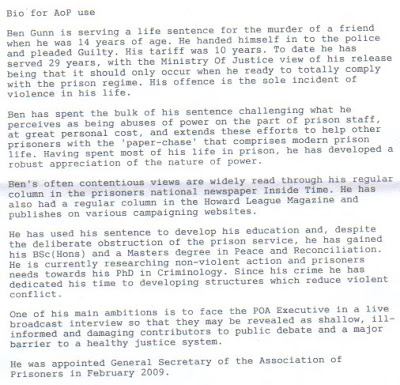
Lifer Ben Gunn announces that he is the newly appointed General Secretary of the Association of Prisoners and challenges all prisoners to play their part in bringing about change
It seems that I have been ‘anointed’; a wizened hand reached down from Hull and passed on the baton that is the General Secretary of the Association of Prisoners - AoP. Perhaps it's because I tweak the management's tail through my comments in Inside Time; or maybe it's because I do love the politics!
Whatever the reason John Hirst, founder of the Association of Prisoners and winner of several important legal challenges, has passed the pen down the line to me. Some of you know me, I have been wandering the landings for 29 years and gracing the pages of Inside Time for so long I'm surprised you aren't sick of me.
What fewer people know is that I began this sentence when I was a youngster, standing in the dock in my school uniform having killed a friend. My tariff was 10 years but due to my bloody-minded refusal to keep my mouth shut I'm still here 29 years later. If there is one thing I just can't stomach it is abuses of power; and as the essence of prison is power, I have found myself at odds with management in most places I've been.
That attitude now sees me at the helm of an Association which has no formal structure and no list of members. In one sense, long may it stay that way; the Prison Service currently forbids us from organising nationally, claiming that we have no shared interests. That is just a reflection of their fear, because all prisoners obviously have shared concerns – we labour under a national set of rules, a national IEP system, a national psychology programme ... to claim otherwise is just plain silly.
One of the legal challenges I intend to make this year in the name of the AoP is against these petty restrictions and to stop the Prison Service saying we are allowed to organise but then throwing up so many barriers as to make it impossible.
However for the moment, we have to work with what we have - no national organisation. For the time being, what I want to do is develop the AoP into a loose collective of individuals who share a similar outlook, spread across the system. These are the people who take the time to help others with the perpetual ‘paper-chase’ that rules our futures; the ones who have the sense to stand up and resist the system’s excesses; the ones who stick their head up above the parapet and say their bit on the landings and in Inside Time.
Look around you; there is one of these people on every landing. There are those driven by outrage or despair; there are those driven by anger; and there are those driven by a deep understanding of the crass waste of life that is imprisonment. Some of these people have only their balls and brass-neck to offer. Some have a particular knowledge of psychology, law, prison, parole or the IEP system. All of these people have their effect and, little by little, change does happen. It may be a screw who thinks twice, or a management policy that is altered, but things do change. Now imagine how much more could happen if all of these professional pains in the arse got together and developed new ideas, swapped tactics to help resist the stupidities that comprise our daily life. Imagine if their particular skills were offered to help other cons who are currently being screwed over.
I want the AoP to foster a network of active prisoners who can all subscribe to the same broad agenda and coordinate between each other. As time passes, and the conditions change, then I would like to see a more formal structure being developed, with a list of members who are able to organise and vote for the Association’s officers. Once our legal challenge is won, then each wing, each prison, will be able to organise and elect its representatives, and the AoP leaders will exist only because you chose them.
Alongside this informal collective, John Hirst and myself will be reaching out to invite support for various aspects of the AoP’s agenda from prisoner-friendly groups and individuals in high positions and low places. As these links develop, we hope that the loose collective of members will become more focused and formal - but still with the same aims.
As well as challenging the restrictions placed on the Association, I can now reveal that I am the un-named party who took up last month’s front page in Inside Time - I am attempting to force the government to deal with the prisoners’ vote judgment that they have avoided for four years. Along with this, I intend to challenge the fact that we are being used as forced labour for outside companies.
But this isn't 'someone else’s struggle'. It is the struggle of every prisoner on every landing to be treated decently. Each of us can play a part, in a thousand small ways. Each time you request a copy of your OASys and demand the errors be removed; each time you write in the food comments book; each time you challenge a psychologist; each time you refuse to be spoken to like an idiot; each entitlement you demand... in itself, each of these is a small gesture, an infinitesimal ripple; however each in itself also speaks volumes; for each is a sign that as individuals we are autonomous, thinking human beings and not rabble to be dismissed and misused.
Each small step any of us takes is an assertion that we are individuals, not 'bodies', and that what we say matters. Each tiny step builds our confidence and shows us that we can make a difference. And once we have that confidence in our own voice, then we can begin to speak louder and more firmly. The future is in our hands. Welcome to the Association of Prisoners.
Wednesday, 1 April 2009
The law should stand up for prisoners too
The law should stand up for prisoners too

By Eric Allison
Throughout my association with the penal system - a link stretching back over 50 years - there has always been talk and hope that, one day, prisoners would gain "rights". And the fight for those rights has not been limited to lobbying. The riots that erupted in the last three decades of the last century, at Hull, Parkhurst, Strangeways, and other jails, had a common cause: in every case, prisoners had reached the end of their tether; their rights, as human beings, had been ignored once too often.
Now, nearing the end of the first decade after the millennium, a new chapter in the struggle has begun. As before, prisoners are leading the way - but this time not on the wings and landings of the system. They are taking their fight to the courts, and they may just have the government on the run.
Later this year, a legal challenge to the government's refusal to give prisoners the vote will be launched. Five years ago on Monday, the right of prisoners to be involved in the electoral process was established by the European court of human rights after a former prisoner, John Hirst, had successfully argued that a high court ruling in 2001, forbidding prisoners to vote, was a breach of his human rights. The government appealed and lost. It then spent two years on a consultation exercise, but refused to publish the results, then announced that another discourse would take place, but will not say when this will begin or end. The fudging may now have to stop.
The challenge, by the newly-reformed Association of Prisoners (AoP), will seek a high court ruling that the ban on prisoners voting is a breach of the Human Rights Act. Lawyers for the AoP will ask the court to order the government to enact legislation allowing prisoners to vote, before the next general election. If the government refuses, an injunction will be issued to prevent the next election taking place.
This challenge has firm foundations. Parliament's joint committee on human rights has stated that "the government must give prisoners the right to vote or the next general election will be illegal under European law. Ministers have been warned."
The Ministry of Justice is running scared on this issue, terrified of the reaction of the tabloids to prisoners becoming engaged in the democratic process. It has suited New Labour, as it suited the Tories before them, to dehumanise prisoners in the eyes of the public. It ignores the fact that, one day, all but a minuscule minority of prisoners will re-enter the society they came from, and that common sense dictates that we engage prisoners in that society as much as possible while they are detained.
Giving suffrage to prisoners will not be a panacea for the ails of the system that holds them. To cite just two problems, it will not stop the scandal of imprisoning, in their tens of thousands, those who, in a just society, would be treated for the mental health problems they suffer from (if you enter a local prison - the jails that receive prisoners from courts - you are more likely than not to be forced to share a cell with a prisoner who has significant mental health problems); and nor will it stop the practice of holding prisoners hundreds of miles from their homes, thereby creating massive problems for their (innocent) families and friends.
It may, however, concentrate the minds of MPs in constituencies where there are prisons - the Isle of Wight, for example, holds around 1,500 prisoners - and force them to address the need for reform. How ironic it will be if it is the judiciary that brings about this change, over the heads of a government that panders to tabloid tastes.
It is said that everyone deserves their day in court. Those who are held in our jails have had more such days than most, and generally see the law as being solely an instrument of punishment. If the law that sent them down now stands up for the rights of prisoners, who knows, maybe some of them will be less inclined to break it in the future.
• Eric Allison writes on criminal justice.
n.b. This post was copy and pasted after 12 Noon and therefore is not an April Fool's Day joke and should be taken seriously.
Sunday, 22 March 2009
Prisoners votes case on The Politics Show
Prisoners votes case on The Politics Show
The Politics Show Yorkshire and Lincolnshire
Fast forward to 30 minutes for discussion of prisoners votes case.
The Politics Show Yorkshire and Lincolnshire
Fast forward to 30 minutes for discussion of prisoners votes case.

Saturday, 21 March 2009
Innocent Inmates Association of Ohio
Innocent Inmates Association of Ohio
Prisoners Are Now Telling You What Really Happens in Your Judicial System and the Prison Business
Prisoners Are Now Telling You What Really Happens in Your Judicial System and the Prison Business
Palestinian prisoners; Israeli diplomats
Palestinian prisoners; Israeli diplomats
By Gideon Rachman
August 2, 2007 10:35am
Life for the Palestinians in Gaza and the West Bank is getting steadily worse. On Wednesday, an Israeli official told me that the Gaza economy is in a “state of total collapse”. Travel for Palestinians on the West Bank is incredibly arduous because of the huge number of Israeli road-blocks.
But – right now – many Palestinians seem more pre-occupied by the internal dispute between Hamas and Fatah than by the Israelis. I got a sense of the bitterness of the dispute when I visited Issa Qaraqe, a Fatah legislator, in his offices in Bethlehem.
Qaraqe runs the Palestinian Prisoners Association, which tries to look after the interests of the 11,000 Palestinians in Israeli jails. He himself was imprisoned for 10 years and then released in 1993. On his office wall is a large poster of Bobby Sands, the first IRA hunger-striker to starve himself to death in a British prison.
But Qaraqe’s take on Hamas is almost as dark as the version you will get from the Israeli foreign ministry. He is not uncritical of his own organisation – and will admit that Fatah has committed human-rights violations and made huge political errors. But Hamas, he says, are Islamist fanatics and the tools of Iran. He says that while Fatah have a secular, democratic and nationalist view of the Palestinian problem, Hamas “approach the Palestinian issue as a religious question, not a national question.” He claims that Gaza is in the early stages of “Talibanisation” – and points to the destruction of the statue of the unknown soldier in Gaza, likening it to the Taliban’s destruction of Buddhist statues.
This is all contentious stuff. Hamas officials point out they won democratic elections and they are at pains to present a moderate and welcoming face to the foreigners who are trickling back into Gaza. UN people and visiting journalists say that security in Gaza is much improved, since the Hamas takeover. But Qaraqe’s hardline take on Hamas accurately reflects the views of Abu Mazen, the Palestinian president. UN people say that the Palestinian Authority in the West Bank is even more insistent on cutting off Gaza economically than the Israelis.
All this leaves the Israelis themselves sitting pretty – at least for now. Few Israelis I’ve met seem to have any real expectations for the latest peace initiative, which they assume will run into the sand.
Israeli officials remain obsessed by the “Iranian threat” – in particular Iran’s support for Hamas and its nuclear programme. By contrast, they seem oddly relaxed about the debacle in Iraq. If the Israelis provoked the Iraq war – as many conspiracy theorists allege – they seem curiously detached about its disastrous outcome.
One official analyst explained that they cannot start producing internal papers about what will happen when the Americans pull out – because they will inevitably leak and cause embarrassment. But, when they focus on the problem, the Israelis do see plenty of reason to worry. In particular, they are anxious that the likeliest outcome is that the US leaves behind a weak Shia-led government that is in Iran’s pocket – thus hugely expanding Iran’s regional clout. And they blame the Americans naïve pre-occupation with democracy for this outcome. When I asked one Israeli official what the best outcome in Iraq would be, he replied – “Find a pro-western Sunni strongman, who will reconstitute the Baath party, hold the country together and keep Iran in check.” I don’t think he was joking.
It is very striking that the Israelis – at least at the level of diplomats and analysts - do not share the Bush administration’s belief in democracy promotion. The term “neo-con” is bandied about with as much contempt as in left-wing London salon. The Israelis see their region in cold, Kissingerian balance-of-power terms. They seem frustrated that America is not doing more to woo Syria away from Iran – something they once again blame on Bush’s tiresome crusade for democracy. As far as the Israelis are concerned, elections in their region have so far brought them an Iraqi government in Iran’s pocket and Hamas. They are not keen to press on with the experiment.
August 2, 2007 10:35am in Middle East
UK: Prisoners' Association criticises White Paper
UK: Prisoners' Association criticises White Paper
* Subject: [prisoner-rights] UK: Prisoners' Association criticises White Paper
* Date: Wed, 17 Jul 2002 15:07:26 +0100
The Association of Prisoners
PRESS RELEASE
Immediate Release - No Embargo
Prisoners' Association
criticises White Paper
An organisation campaigning for the rights of prisoners has criticised the
White Paper, "Justice for All", published this afternoon by the Home Secretary.
General Secretary of the Association of Prisoners, John Hirst, said today:
"Justice for All is not the piece of carefully
considered legislation that we need. It amounts to
little more than knee-jerk reaction to public concerns,
many of which are unfounded."
Mr Hirst, who is serving a life sentence at Sudbury prison in Derbyshire,
also criticised plans to increase magistrates' sentencing powers to twelve
months. "If you want a plan guaranteed to increase the prison population
overnight, then you've found it. It will also lead to more people opting
for a Crown Court trial in the hope of being found not guilty - but costing
the taxpayer millions."
"What is needed is a concerted effort at reinforcing public confidence in
the criminal justice system, then allowing a reduction in the prison
population. For as long as the public see a community penalty as a 'let
off', a reduction in the prison population would be political suicide," he
added.
ENDS
Subscribe to:
Posts (Atom)